
Zest buyers are forced to wait up to six weeks for the automated manual transmission version, available only on this car in the compact sedan segment.
Carmakers Mercedes-Benz, Audi, Renault, Kia India and MG Motor on Wednesday announced plans to hike vehicle prices from January to partially offset the impact of rising input costs. They join the likes of market leader Maruti Suzuki India and Tata Motors, which have also made the year-end announcements to raise prices from next month. Audi India said it will increase prices of its entire model range by up to 1.7 per cent, while Mercedes-Benz India noted it will hike the prices by up to 5 per cent from January 1.

Why Kia is keen to drive into India? The Korean automobile maker plans to carve out a niche for itself in the crowded Indian market with its compact sedans and SUVs.
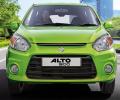
Maruti Suzuki, Tata Motors and Hyundai stand to gain the maximum, given their large portfolio of products in the sub-4 meter segment.
The strong domestic growth for new vehicle sales during 2008-12, which witnessed a compounded annual growth rate of 14 per cent, led to an increased inventory of used cars, thanks to trade-ins.

Various factors, including robust demand in rural markets and good response to new models, helped in driving the sales.

Japanese auto major Nissan on Wednesday said it is discontinuing Datsun brand in India, nine years after the company kicked off the marque's global relaunch in the country. Having failed in its ambitious global relaunch of Datsun, Nissan had in 2020 discontinued the brand in Russia and Indonesia, the other two countries along with South Africa and India which were marked as key markets targeting the entry level car segment. Confirming the move to discontinue the Datsun brand, Nissan India in a statement said, "Production of Datsun redi-GO has ceased at the Chennai plant (Renault Nissan Automotive India Private Ltd). "Sales of the model still continue (till the stock lasts)."

For players like Toyota Kirloskar and Ford, the contribution of UVs to overall sales is now well over 60%.

The company sells a range of vehicles from three-wheelers to high-end sports utility vehicles.

Corporate India is starting to step up its capital expenditure plans amid government incentives and signs of rising demand, company executives and analysts have indicated. This coincides with the Reserve Bank of India (RBI) recently citing a double-digit growth in private capital expenditure. Healthy balance sheets of banks and corporates, along with increasing capacity utilisation and improving business sentiment, are contributing to a favourable environment for sustained growth in private sector investments, the RBI said in its policy last week.

Tata Motors is giving a much stronger focus on the design of its cars, from planning product life cycle in a better way to incorporating subtle Indian elements to its future models.

Code-named Pelican, bigger hatchback with new petrol and diesel engines may hit the road next year.

One can see the scale of recalls going up as the market expands.
Reflecting the mood, passenger vehicle sales in November either remained muted or skidded for most manufacturers as high fuel prices and the higher cost of borrowing dampened buying sentiment.

The electric vehicle evolution in India's passenger vehicle market has remained frozen in time and may see limited adoption over the next decade, experts say.

White is easy to maintain, looks brighter than other colours over a longer period, is the least commonly rejected colour among family members, has high resale value, provides better safety at night, absorbs less heat in the summer season, makes small cars look bigger, and is not considered inauspicious.

Car makers are trying hard to boost sales in India.
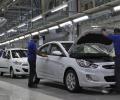
Scooters, once the fastest growing sub-segment, also declined for the second consecutive month in September.

India wasn't applying widespread crash testing like foreign countries do, so manufacturers didn't see the need for an investment focus on safety. Customers rarely walked into showrooms asking for the safest car. They wanted the cheapest or the most fuel-efficient or the best-looking car.

Car sales likely to touch record 3-mn mark by the end of March.

Ahead of the peak festive season, India's passenger vehicle makers are staring at a cumulative order backlog of nearly 500,000 units as chip shortage continues to cripple production. The crisis is forcing companies to change their production plans frequently and take a call on the variants they can manufacture based on the availability of semiconductors. The booking numbers are not a true reflection of demand, said manufacturers.

Hyundai Motor India will raise prices of its entire product portfolio in the range of Rs 5,000 to Rs 25,000 from Jan 2015.

Market leader Maruti Suzuki sold 51,274 units, down 49.61 per cent from the same month last year. Hyundai Motor sold 21,320 units, a decline of 49.25 per cent and Mahindra & Mahindra sold 8,075 units, down 54.54 per cent.

Global NCAP strongly believes that no manufacturer anywhere in the world should be developing new models that are so clearly sub-standard.

For Mahindra & Mahindra (M&M), which has just started executing a comeback strategy for wresting back ground it lost to rivals, this could not have come at a worse time. The maker of the Bolero Neo and the Thar models on Thursday said it would have to halt production at its automotive plant for a week due to the worsening supply situation of semiconductors.

Japanese auto major Nissan unveiled its compact car redi-GO under the Datsun brand that will hit markets in June.

Close to half a dozen more three-row premium mid-size models are expected to hit the road over the next two years.

After GM's India exit, Ford-Mahindra 'strategic alliance' under spotlight.

Maruti Suzuki posted a marginal increase in January and the likes of Hyundai, Ford and Mahindra & Mahindra reporting a single-digit growth.

The Baleno excels in most departments, leaving little scope for improvement in some.

German car-maker Volkswagen on Thursday said it will increase its vehicle prices by up to 2.5 per cent in India from next month in order to offset impact of high input costs.

Most of the major car makers in India, including Maruti Suzuki and Hyundai, do not sell cars through internet but use the online medium to convert queries into offline sales through dealerships.

Carmakers fear an increase of Rs 35,000-40,000 per vehicle for safety equipments.
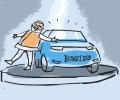
From Hyundai to Tata Motors, automakers are staring at a bleak future. With no succor provided in the Budget, the pain for companies is likely to continue for the next two quarters.
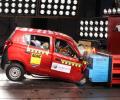
Rita Mozumdar argues small vehicles have not passed the frontal impact test as required under the law

With the threat of a third Covid-19 wave looming large, companies are scrambling to protect employees and keep operations safe--from a no-jab-no-entry-at-workplace policy to ramping up vaccination, it's an all-out effort to prevent the scale of devastation seen in the first two waves. At least two top steel companies--Tata Steel and ArcelorMittal Nippon Steel India (AM/NS India)--are pushing for vaccination certificates for entry into work premises. AM/NS India, a joint venture between world's leading steelmaker, ArcelorMittal, and Japan's Nippon Steel, is set to make vaccination the certificate a requirement from July 1.

New Creta, petrol Vitarra Brezza.. A quick look at what went down at Auto Expo Day 2.
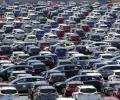
Commercial vehicles however declined by 2.83%

Most of the hirings are, however, in the entry or junior level.

Move aimed at removing confusion among private buyers
 © 2026 Rediff.com - Advertise with us - Disclaimer - Privacy Policy - Sitemap - Feedback - About us - Terms of use - Grievances